
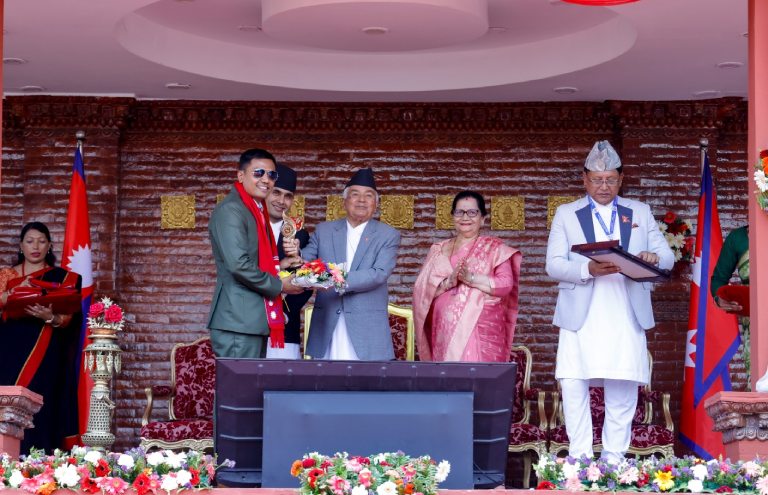
Kathmandu: Audiences see actors on screen, hear dialogues, and become immersed in stories through moving visuals. Yet the person who brings those visuals together in the right sequence, pace, and emotion often remains behind the scenes. Film editor Nahakul Khadka, who has dedicated nearly two decades to this creative craft, has been honored with the Best Film Editor Award at the National Film Awards 2082.
Receiving the award from the Right Honorable President, Khadka described the recognition as a significant achievement resulting from years of hard work, dedication, and commitment to the art of film editing.
Among the films he edited that were in contention for this year’s awards were Ke Ghar Ke Dera: Ghar No. 2, Kosedhunga, and Haribahadurko Jutta. Earlier, he had also won the Best Editor Award at the Nepal Rural Film Festival.
Born in Dhankuta, Khadka has been actively involved in the Nepali film editing industry for the past 19 years. He began his career as an assistant editor, progressed to associate editor, and eventually established himself as a chief editor.
Over the course of his career, he has worked on more than 200 films as an assistant editor, associate editor, and editor. Within the film fraternity, he is known as a calm, responsible, and highly dedicated professional. Colleagues describe him as someone who prioritizes his work over publicity.
His years of experience in the editing room have given him a deep understanding of cinematic language, narrative structure, and the emotional journeys of characters. While film editing is often perceived simply as the process of cutting and joining scenes, its role extends far beyond that.
Critical decisions such as which scenes to retain, which to remove, which take to select from multiple versions, and how to transition smoothly from one scene to another are all made during the editing process. An editor determines the pace of a film, creates rhythm between scenes, and shapes the emotional impact a story has on its audience.
Selecting the most effective moments from hundreds of scenes and thousands of clips to create a compelling narrative requires patience, technical expertise, and creative vision. Khadka has been carrying out this responsibility with consistency and dedication for well over a decade.
The technology used when Khadka entered the profession is vastly different from today’s digital editing systems. With the emergence of new software, digital workflows, and evolving filmmaking techniques, editors must continually update their knowledge and adapt to changing industry standards. Khadka has successfully embraced these changes while maintaining his active presence in the field.
An editor’s role is to weave together a director’s vision, a cinematographer’s visuals, and an actor’s performance into a seamless narrative flow. For this reason, film editing is often referred to as the “final writing” of a film.
The National Film Award has brought national recognition to Khadka’s contribution to Nepali cinema. He acknowledges that the honor also carries greater responsibility to deliver even more refined and high-quality work in the future.
His achievement has further highlighted the importance of editors and other technical professionals who work behind the scenes in filmmaking. Alongside actors and directors, editors, cinematographers, sound technicians, and art directors play vital roles in bringing a film to life. However, public recognition of these creative professionals often remains limited.
Nahakul Khadka’s success is not only a personal milestone but also a tribute to the contributions of all technical professionals working behind the scenes in Nepal’s film industry.