
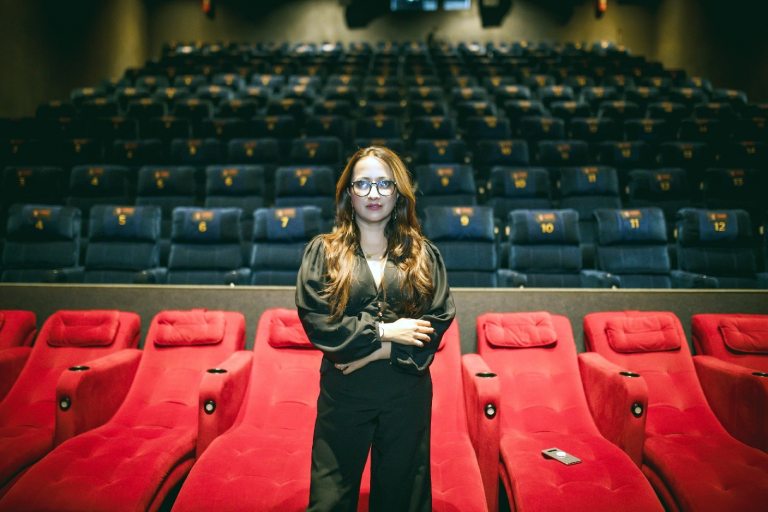
With more than a decade of dedicated engagement in Nepal’s film industry, Jenish Pahari (Shrestha) has built her professional journey across the different dimensions of cinema from distribution to exhibition, marketing, business development, content acquisition and international industry relations and overall growth of the entertainment sector..
Her experience has given her something increasingly important for the growth of Nepal’s film sector: an understanding of cinema as a complete ecosystem.
For her, the development of the film industry cannot be limited to filmmaking alone. A sustainable cinema sector requires a strong connection between creators, producers, distributors, exhibitors, audiences, technology, investment, policy and international markets. Her professional experience across these interconnected areas has allowed her to understand both the creative and commercial realities of the industry.
Adding another important dimension to her professional profile is her academic and legal background. Holding a Master’s degree as well as a law degree and professional experience as an advocate, she brings together industry knowledge with an understanding of legislation, regulation, governance and institutional frameworks. This combination provides a perspective that connects the practical realities of the film business with the legal and policy structures necessary for its long-term development.
Over the years, she has also represented Nepal at various international film festivals, markets, conferences and industry platforms, engaging with filmmakers, producers, distributors and other stakeholders from different countries. These international engagements have been driven by a larger objective: to create opportunities for collaboration, co-production and stronger cultural and economic bridges between Nepal and the international film community.
Her participation in international platforms has also strengthened her understanding of how established and emerging film markets operate, and how Nepal can position itself within the wider regional and global cinema landscape.
Her extensive exposure to distribution, production and exhibition has given her a practical understanding of these challenges. She understands the realities faced by filmmakers and producers, the commercial dynamics of distribution, the importance of exhibition infrastructure and audience development, and the need to create stronger connections between Nepalese cinema and international markets.
At the same time, she places considerable emphasis on inclusivity within the film industry. She believes the future of Nepalese cinema must create greater opportunities for women and young professionals—not only as performers and filmmakers, but across every level of the industry, including production, technology, business, distribution, exhibition, leadership and policymaking.
For her, bringing more women and young people into cinema is not simply a question of representation. It is also about bringing new ideas, new technologies, new business models and new perspectives into an industry that is constantly evolving.
As a woman who has spent more than a decade working within the cinema business, she brings a perspective shaped by both professional experience and firsthand understanding of the opportunities and challenges within the sector. Her journey has been rooted in the industry itself, giving her insight into its day-to-day realities while also allowing her to look at its broader institutional and economic potential.
Her vision is therefore not limited to promoting films. It is about building an ecosystem in which Nepalese cinema can become more professional, competitive, inclusive and internationally connected.
This includes strengthening the relationship between the government and the private sector, improving institutional and regulatory frameworks, encouraging investment, developing talent, expanding international partnerships, facilitating co-productions and creating greater opportunities for Nepalese films and filmmakers to reach audiences beyond Nepal.
With her combination of more than a decade of industry experience, legal and academic knowledge, international exposure, and practical understanding of production, distribution and exhibition, she represents a generation of film professionals who see cinema not merely as entertainment, but as a cultural industry with significant economic, social and international potential.
Her journey reflects a larger belief: Nepal does not lack stories or talent. The opportunity now lies in building the structures, connections and ecosystem that can allow those stories and talents to reach their full potential.